
Starting an SSI Open Water course in Bali should not feel like a race against the clock, or a sequence of exercises completed in the middle of a large group. It is your first scuba certification, the one that opens the door to future underwater journeys. In Tulamben, it can also become a real highlight of your stay: learning at an easy pace, building confidence and discovering marine scenery you will never forget.
At Scuba Tribe, every course is private. You have your own instructor, your own pace and a programme suited to your comfort in the water. You will never be grouped with unfamiliar travellers. Whether you come alone, as a couple, with family or with friends, the aim remains the same: to give you the attention you need to learn thoroughly in a relaxed atmosphere.
What does the SSI Open Water certification allow you to do?
The SSI Open Water Diver certification is the first complete qualification for becoming an independent diver, with a certified buddy. Once earned, it generally allows you to dive to a depth of 18 metres anywhere in the world, subject to local conditions and your experience.
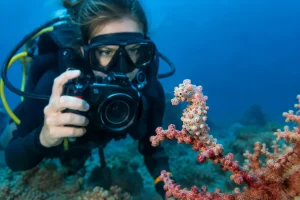
But the certification is not simply a card to show at a dive centre. It teaches you how to prepare a dive, use your equipment, communicate underwater, manage your buoyancy and respond calmly to simple situations. These foundations profoundly change the experience: instead of staying focused on what to do next, you begin to observe the reef, follow a butterflyfish or remain still in front of a turtle.
The minimum age, medical requirements and ability to swim must be checked before starting. A good general level of fitness is helpful, but there is no need to be an athlete. The key factor is above all your comfort in the water and your willingness to take the time to learn.
Why take an SSI Open Water course in Bali?
Bali offers very different conditions depending on the region. Tulamben is especially popular with beginners because several sites can be accessed from the shore. No long boat crossing before every lesson, no schedule dictated by a group departure: you enter the water just a few steps from the centre, with time to get settled and debrief.
This simplicity has real educational value. After an exercise, your instructor can explain a movement, let you catch your breath, then continue when you are ready. For people who feel a little apprehensive about going underwater, the shore also provides a gradual and reassuring entry.
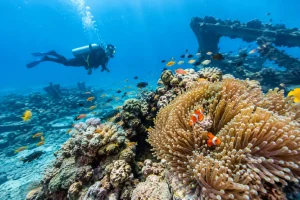
The setting remains spectacular. Tulamben’s reefs are home to abundant marine life, including reef fish, coral gardens and many small creatures that reward attentive eyes. Depending on your progress and the conditions, training dives may also take you near the USAT Liberty, Tulamben’s iconic wreck. This is not a promise of the same itinerary for everyone: safety, weather and your comfort level always come first. But learning in surroundings that make you want to stay underwater certainly helps.
A programme designed around your progress
An Open Water course combines theory, shallow-water exercises and open-water dives. With SSI, the theory section can be prepared in advance using digital materials. It is an excellent way to dedicate more of your stay to practical training, but it never replaces discussions with your instructor. The essential concepts are reviewed together so that you understand what you are doing, and why you are doing it.
The first sessions are designed to help you become familiar with the equipment and breathing through a regulator. It is normal for this to take a few minutes. Some students feel comfortable from their first immersion; others need to slow down, repeat an exercise or stay a little longer where they can stand. A private course makes all the difference at that point. Your instructor can adjust the pace without having to follow another participant’s rhythm.
You will then learn to clear a mask, recover a regulator, control your buoyancy, share an air source and ascend in a controlled manner. These exercises are not there to put you to the test. They give you simple reference points so diving remains enjoyable, even when a small unexpected situation arises.
The sea dives gradually connect these skills with exploration. You will practise descending, communicating with your buddy, managing your position in the water and observing your surroundings. Between dives, debriefings are just as important as time underwater. This is where questions receive practical answers and progress becomes visible.
How many days should you allow?
In general, allow three days to complete the course comfortably, particularly if you have completed part of the theory before arriving. However, the best schedule depends on your previous experience in the water, the weather, your availability and your learning pace.
Wanting to finish quickly is understandable when holidays are short. Yet allowing a little extra time is often the best choice for a first certification. You will get more from every dive, have less information to absorb in a single day and be able to rest properly. After the course, ideally keep one day without diving before flying.
The comfort of an organised stay in one place
Logistics can easily make a diving course feel more demanding: transfers to the dive centre, finding a restaurant between sessions, returning late to the hotel, preparing for the following day. In Tulamben, you can have accommodation, meals, a pool and your course all in one place. This leaves more room for what matters: sleeping, eating, staying hydrated and arriving relaxed for your next immersion.
This arrangement is particularly suitable for couples where only one traveller is taking the course, as well as for families. While one participant is in training, the others can relax by the pool, explore the surroundings or arrange their own activities. For friends, a dedicated instructor also makes it possible to coordinate the programme without placing you in an outside group.
In the evening, conversation often returns to those first moments underwater: the sound of bubbles, the unexpected calm, the smile exchanged behind a mask. The atmosphere remains friendly, while your learning still retains its own space and individual attention.
Preparing for your arrival in Tulamben
Bring a swimsuit, suitable sun protection, light clothing and a water bottle. Diving equipment is provided for the course, but if you already own a mask that fits you perfectly, it can be nice to bring it along. Mask issues are rarely serious, but a comfortable fit always makes those first immersions easier.
Avoid planning a very physical activity the day before the course, and arrive well rested if possible. If you have any medical concerns, discuss them before your stay rather than discovering them at the last moment. Being honest about your health and your comfort in the water helps the team support you properly.
Above all, do not compare your progress with that of another diver. Some people learn technical skills quickly and need more time with buoyancy; for others, it is the opposite. A good course does not reward rushing. It builds confidence that will stay with you on every reef, every wreck and every future journey.
Your first certification deserves more than a packed schedule. Take your time underwater, ask your questions and let Tulamben make you want to return. Your stay, your pace, your Tribe.

 FR
 DE
 NL
 EN
 ID
 JA
 KO
 ZH

