
Just a few steps from shore, diving the Drop Off wall in Tulamben suddenly takes on a whole new scale. The volcanic seabed, initially accessible and bright, transforms into a wall descending into the deep blue. This contrast is what makes the site so striking: an easy beach entry, followed almost immediately by a feeling of being out in the open ocean.
For certified divers wishing to discover another side of Tulamben beyond the USAT Liberty wreck, Drop Off is a remarkable choice. The site can be serene and contemplative, or offer a more dynamic dive depending on the swell, light and chosen profile. With a private guide, you do not have to follow the pace of an unfamiliar group: you can take the time to observe, stabilise and enjoy every level of the wall.
Why Tulamben’s Drop Off wall is so unique
Drop Off was created by the volcanic activity of Mount Agung. An ancient lava flow formed a spectacular drop-off, very close to the coast. While many underwater walls require a boat trip and precise navigation, this one begins right from shore. You enter the water from a black pebble beach, then gradually reach the reef before the terrain opens up.
This topography makes for a very easy-to-read dive. Near the surface, coral formations and reef fish fill your view. As you move along the wall, the play of light becomes more pronounced and the blues deepen. The drop-off is not an invitation to descend without limit: above all, it is a vertical landscape rich in detail, best explored with good buoyancy and depth management.
It is also a site that rewards curiosity. Look at the wall as much as the blue: sea fans, sponges, small colourful fish and crustaceans hide in its crevices. Depending on conditions and the season, schools of trevally, fusiliers or more pelagic fish may pass offshore. Nothing is guaranteed in the ocean, but the terrain creates a wonderful sense of space and always leaves room for surprise.
What a dive at Drop Off is like
Entry is generally from the shore. The pebbles can require a little care when wearing fins, especially when the sea is moving, but access remains direct and practical. Once you are geared up, there is no long boat journey or schedule dictated by passenger rotations.
The dive often begins on a gentle slope, at a comfortable depth. It is the ideal time to check your weighting, slow your breathing and get used to the day’s visibility. The wall then appears, dropping more sharply into the depths. Your guide will adapt the route to your certification, air consumption and comfort level.
A classic profile is to follow the upper section of the drop-off without trying to go deep. This area already offers a wide variety of marine life while allowing plenty of time to explore calmly. Experienced divers may enjoy a slightly more committed profile, within the limits of their training and the conditions. For a first wall dive, staying shallow and taking time to master your position is often the most rewarding option.
The ascent gradually leads back to the shallow reef. This is where many divers relax their attention too soon, even though there are often beautiful scenes still to observe: parrotfish, butterflyfish, nudibranchs or small shrimps in the crevices. A successful dive at Drop Off is not measured by the maximum depth reached, but by the quality of the time spent along the wall.
The best time to dive
Tulamben is a year-round diving destination, although conditions vary. Mornings often bring calmer seas and soft light over the reef. This can be especially suitable for divers who prefer a calm shore entry or wish to combine Drop Off with a second site on the same day.
Visibility depends on the weather, swell and local conditions. After heavy rain or when the sea is rough, it may be more limited. This does not necessarily make the dive less interesting: softer visibility can enhance the wall’s atmosphere and encourage closer observation. However, divers primarily looking for wide blue vistas will appreciate calm, clear days.
What level is required to dive at Drop Off?
Drop Off is well suited to certified Open Water divers, provided they are comfortable in the water and respect the maximum depth of their certification. The wall creates a striking impression of depth. Good buoyancy control is therefore more valuable than seeking performance.
Recently certified divers will find it an excellent setting to learn how to move alongside vertical terrain, with particular attention to orientation and stability. Experienced divers, meanwhile, can refine their profile, spend time observing the life attached to the wall and tailor their exploration to their interest in photography, wide-angle images or macro marine life.
For a Discover Scuba experience, the choice of site depends on each participant’s actual comfort level, sea conditions and the instructor’s assessment. A first underwater experience should remain simple, supervised and enjoyable. The drop-off can be beautiful, but there is no need to choose it if a more sheltered reef is better suited to your first breath underwater.
What makes the difference: diving at your own pace
At a site as visually striking as Drop Off, a private dive brings real value. You do not need to rush because another diver uses their air more quickly, or wait away from what interests you because the group has a different objective. Whether you want to photograph a sea fan, work on your buoyancy or simply spend a few minutes facing the blue, the pace can follow your experience.
At Scuba Tribe, every booking has its own guide or instructor. Couples, families, solo travellers and groups of friends are never mixed with guests they do not know. This approach is particularly valuable at Drop Off, where preferences can differ greatly: some want a calm, shallow profile, while others wish to devote more time to photography or explore the wall with a guide attentive to small details.
This freedom does not replace safety rules. On the contrary, it makes them easier to follow. Your guide checks the conditions, sets a suitable plan, monitors air management and adapts the dive if the sea or your comfort requires it. A private outing does not mean doing more than necessary: it means doing what suits you, with proper support.
Preparing well for your shore outing
A little preparation makes the experience much smoother. Tulamben’s pebbles can be uncomfortable barefoot: well-fitting dive booties are particularly useful. Also take time to adjust your equipment before entering the water. A leaking mask or poorly secured fin is easier to fix on the beach than when the wall appears in front of you.
Bring sun protection between dives and a light layer for after your outing, even on a warm day. Sun, salt and surface intervals are more tiring than one might think. Hydration, a light meal and recovery time are all part of a good diving day, just as much as the briefing.
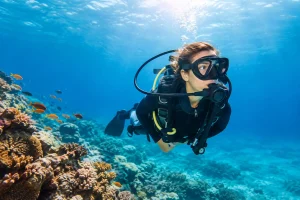
If you bring a camera, do not try to capture everything in the first minute. At Drop Off, the strongest images often come from a patient approach: a diver silhouetted against the blue, the textures of a sponge, a colourful detail on the wall. Stabilise yourself, look around, then choose your subject.
Respecting the reef and the terrain
A healthy wall remains fragile. Keep your fins away from the wall, avoid holding onto corals and watch your movements when observing an animal up close. Calm buoyancy protects the site, improves your photos and makes the dive more relaxing.
Also avoid chasing marine life into the blue. The most memorable encounters often happen when you remain still, attentive and discreet. Your guide knows the site’s habits and can help you notice what you might otherwise have passed by.
Drop Off does not need to be conquered. It deserves to be explored slowly, with enough time to let your gaze descend into the blue, then return to the living details of the wall. Choose a calm time slot, suitable supervision and a pace that suits you: this is often how a simple drop-off becomes one of Tulamben’s most memorable experiences.


 FR
 DE
 NL
 EN
 ID
 JA
 KO
 ZH

